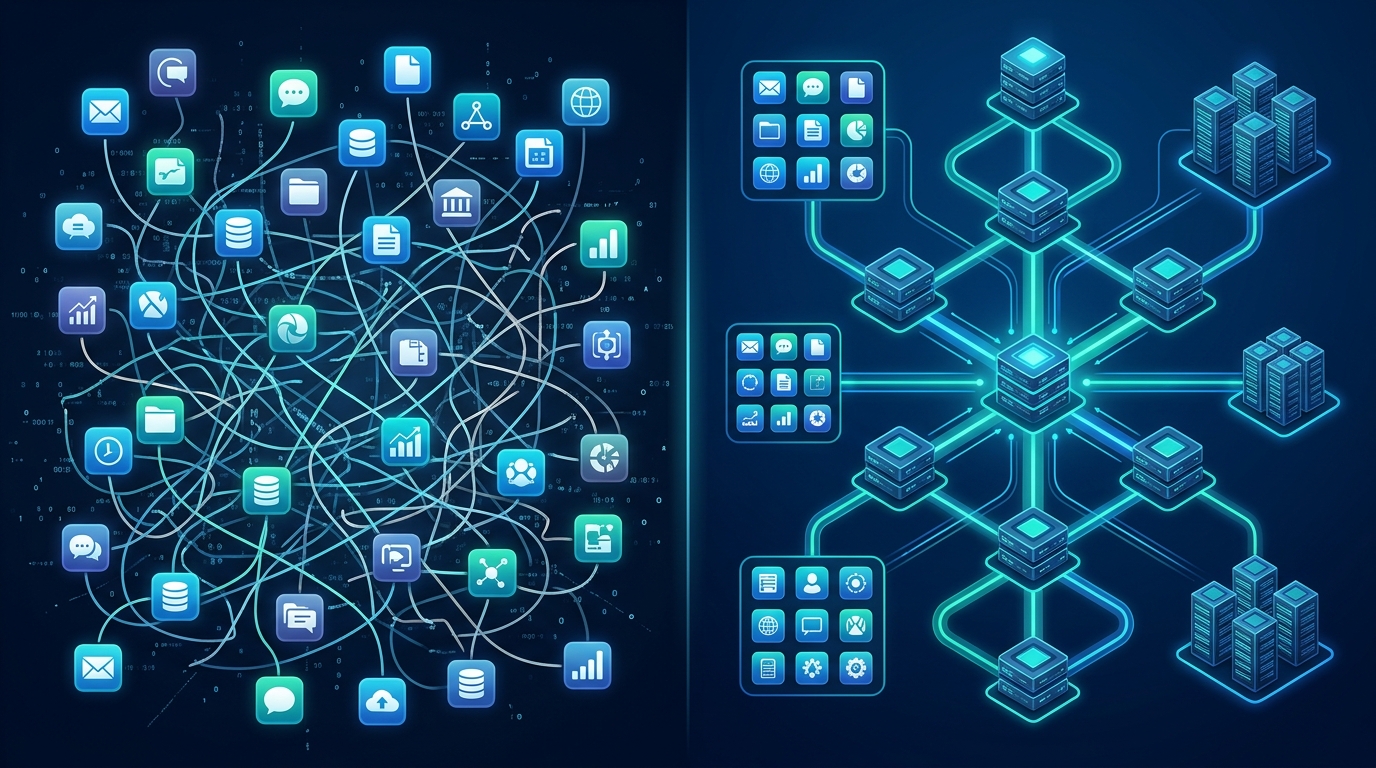
Why does the standard approach to digital transformation create friction?
Late last year, I sat down with an operations director whose team was actively drowning in their own digital toolkit. They were jumping between eighteen different daily business apps, copying data manually from one screen to another. He asked me a very practical question: why was his expensive new technology making his team slower? When I evaluate digital transformation strategies for our clients, I find they frequently face a choice between purchasing disconnected off-the-shelf software and building custom, unified systems. SphereApps operates on the principle that the most effective approach is a connected digital portfolio—where cloud infrastructure, mobile applications, and artificial intelligence operate as a single ecosystem rather than isolated utilities.
As a software development company specializing in these connected environments, we frequently analyze how organizations purchase and deploy technology. The default reflex for most teams is to buy a new app for every new problem. Over time, this creates a fragmented architecture that degrades performance, frustrates users, and traps data in functional silos.
How do isolated applications compare to a connected portfolio?
To understand the current enterprise technology environment, we have to look at the volume of software being produced. According to recent market analysis from Sensor Tower and Itransition, forecasters project 292 billion global mobile app downloads annually by 2026, with the global market size estimated to reach $378 billion. While the market is saturated with highly specific tools, more tools do not equal better workflows.
When evaluating how to equip your team, the comparison generally breaks down into two distinct approaches:
The Isolated Application Approach
This involves buying or building standalone solutions designed to do exactly one thing.
- Pros: Fast initial deployment, highly specialized feature sets, and lower immediate upfront costs.
- Cons: High long-term maintenance, severe data isolation, workflow bottlenecks, and high cognitive load for end-users who must constantly switch contexts.
The Connected Ecosystem Approach (The SphereApps Model)
This involves architecting a digital environment where data flows freely between specific user interfaces, backed by centralized cloud solutions.
- Pros: Drastically reduced duplicate data entry, unified security protocols, scalable architecture, and a workflow that matches how employees actually work.
- Cons: Requires heavier initial architectural planning and a deeper understanding of overarching business processes.
In my experience as a PM, we always advocate for the latter. Building useful technology is not about cramming features into a standalone product; it is about mapping the precise way data needs to move from a user's mobile device to the central database and back again.
How do you choose between standard utilities and custom development?
The build-versus-buy debate is one of the most common decision frameworks I walk clients through. Many organizations mistakenly believe they need custom software when a commercial product would suffice, while others try to force a generic product to handle a highly proprietary business process.
Here is how I recommend evaluating the choice:
- When to Buy Off-the-Shelf: If your requirement is a standardized, universal business function, commercial software is usually the right choice. For example, if your sales team simply needs basic contact management, a standard commercial CRM is perfectly adequate. If your legal team needs to merge and sign contracts, a standard PDF editor works fine. These processes do not offer a competitive advantage; they are administrative necessities.
- When to Build Custom Solutions: You should invest in custom development when the software handles a process entirely unique to your operational model, or when commercial apps refuse to communicate with your core database. If your CRM needs to automatically trigger a proprietary manufacturing sequence based on real-time sensor data, off-the-shelf applications will fail. Custom architecture allows you to define exactly how systems interact.
What happens when hardware fragmentation dictates your software strategy?
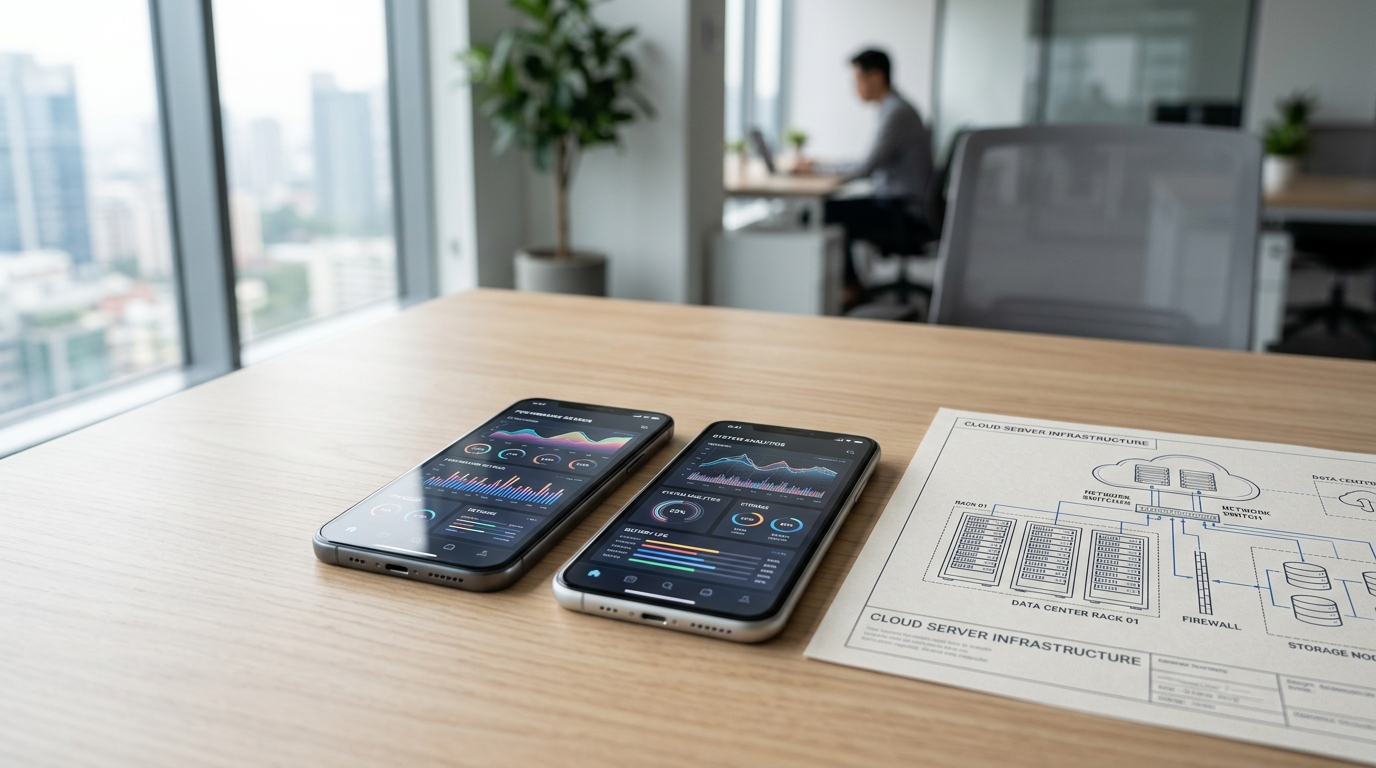
Another critical comparison in modern development is how software handles physical hardware differences. Digital Consumer Trends reports from Deloitte note that roughly 95% of adults now own a smartphone, and these devices are fast becoming all-in-one digital hubs for payments, identity, and personal data management. However, not all devices are created equal.
If you build applications that rely heavily on local device processing power, you immediately run into hardware fragmentation. In a typical mid-sized company, you might have field workers using an older iPhone 11, while executive teams operate an iPhone 14 Pro.
The Device-Dependent Model
Relying on the phone's internal processor to handle complex data sorting or AI tasks means the application will run fast on high-end models but may crash or freeze on older hardware. This creates an inconsistent user experience and generates endless support tickets.
The Hardware-Agnostic Cloud Model
By offloading heavy computation to remote servers, the mobile device simply becomes a glass interface. As backend architect Koray Aydoğan explained in his breakdown of hardware-agnostic design, this ensures performance parity across the entire hardware spectrum. Whether a user is holding a five-year-old device or the newest model, the workflow remains identical.

Why is AI deployment lagging behind consumer adoption?
Artificial intelligence is the most heavily debated variable in software engineering right now. The difference between adopting AI as a consumer and deploying it as an enterprise system is stark.
Deloitte's Tech Trends research highlights this disconnect perfectly. While leading generative AI tools have reached hundreds of millions of weekly users, enterprise implementation tells a different story. Reports indicate that only a small fraction of surveyed organizations (roughly 11%) have successfully deployed agentic AI systems into production. The primary blockers? Legacy system integration, data architecture constraints, and inadequate governance frameworks.
Surface-Level AI Implementation
Many vendors simply slap a chat interface onto an existing product and call it an AI solution. This is a fragile approach. It allows users to ask questions about data, but it cannot actively execute workflows, correct database errors, or sequence complex operational tasks.
Structural AI Integration
At SphereApps, we view intelligent systems as core infrastructure rather than surface features. True AI-powered digital transformation happens at the data layer. It involves structuring your databases so that agentic systems can securely read, interpret, and execute actions without breaking existing compliance rules. It is the difference between a tool that tells you what your data says, and a tool that actively manages that data for you.
How does a traditional vendor differ from a domain-focused development partner?
When organizations hire external teams to build digital products, they usually engage in a traditional vendor relationship. The client writes a rigid list of feature requirements, the vendor builds exactly what is on the paper, and the product launches.
The problem with this model is that clients are often guessing at what features will actually solve their workflow problems. If the underlying assumption is wrong, the resulting software is useless, even if the code is perfectly written.
A domain-focused partnership operates on a completely different metric of success. We do not start by asking what features you want; we start by analyzing where your data gets stuck. As Hazal Şen recently noted in her post on aligning product roadmaps with user needs, a genuinely useful product connects business priorities with technical reality. We compare the cost of building a feature against the actual time it saves an end-user. If a proposed feature does not measurably reduce friction, it does not get built.
Who actually benefits from transitioning to a connected ecosystem?
Not every organization needs a complete architectural overhaul. If your team is small, your data is simple, and your off-the-shelf tools are functioning well, introducing custom architecture might be an overreaction.
However, you are the right candidate for a unified digital portfolio if:
- Your employees spend more than an hour a day manually moving data between different systems.
- You are paying enterprise licensing fees for software where your team only uses 10% of the available features.
- Your field workers cannot complete basic tasks because their mobile devices cannot process the required local data.
- You want to implement agentic AI, but your current data is locked inside closed, proprietary vendor ecosystems.
Ultimately, software should be quiet. It should sit securely in the background, facilitating human work without demanding constant attention. By comparing your current fragmented tools against the potential of a connected ecosystem, you can stop managing applications and start managing outcomes.